
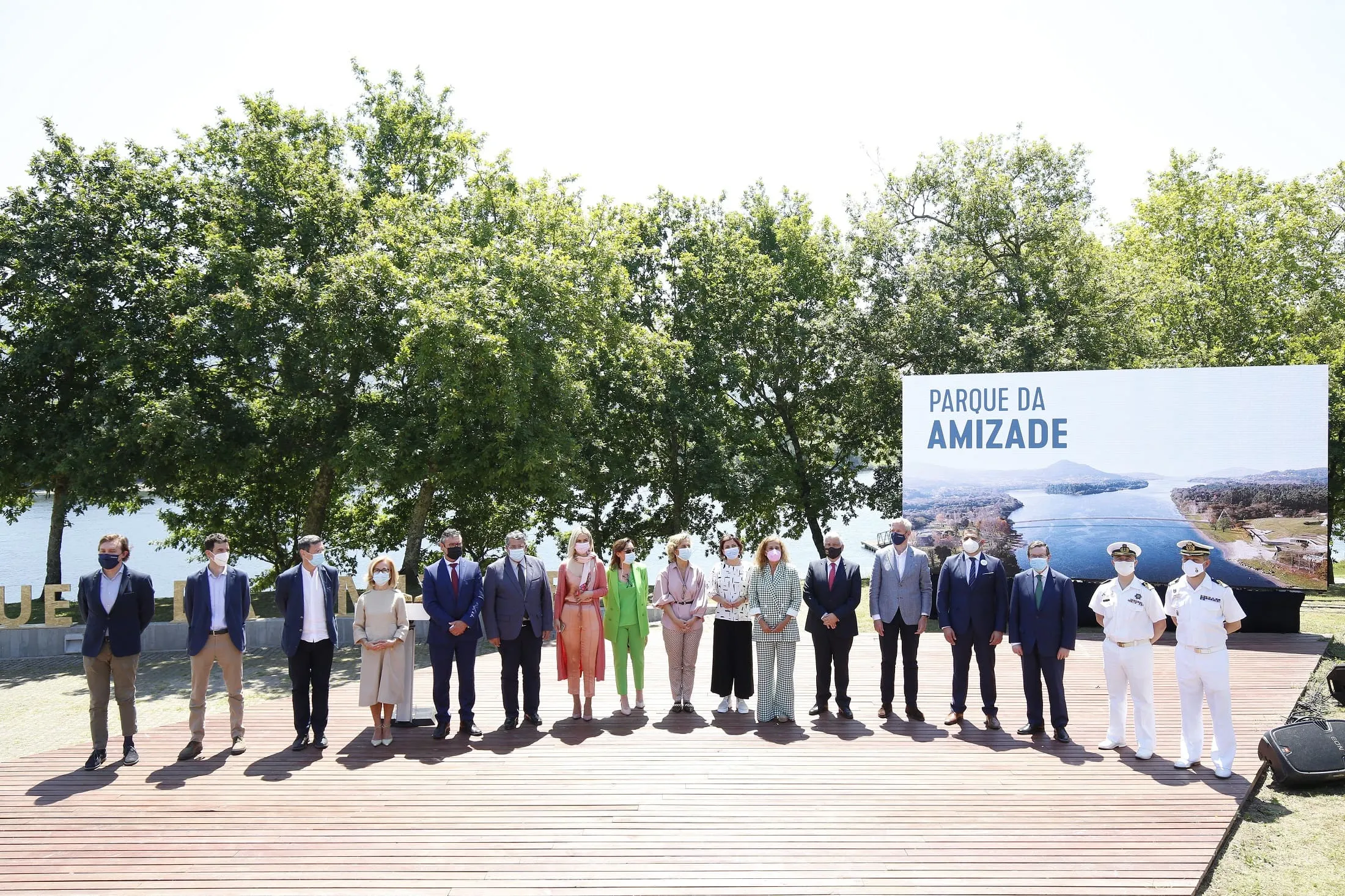
Goián and the Parque do Casteliño will merge into a single park without regard to borders: the Tomiño-Cerveira Friendship Park. A “Euro-area” of 25.6 hectares connected by a new pedestrian and cyclist bridge, which will provide a shared public, urban, and recreational space, making it the only cross-border park in the Euroregion and one of the largest in all of Europe.
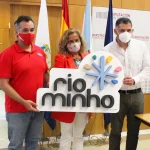
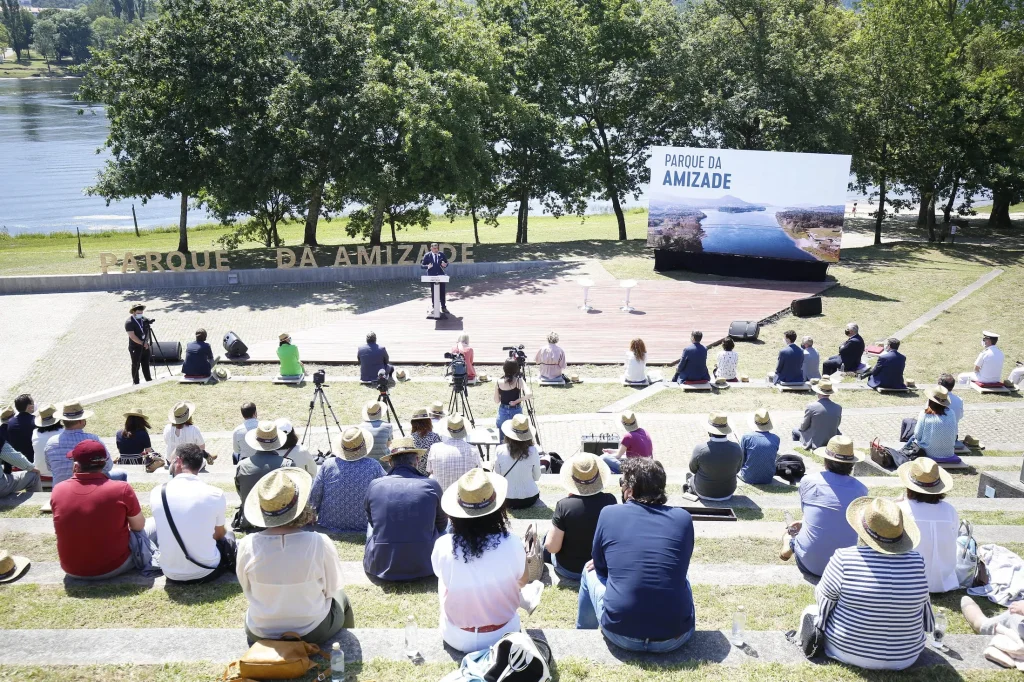
O proxecto foi presentado hoxe oficialmente nun acto presidido pola presidenta da Deputación Carmela Silva e o deputado de Cooperación Transfronteiriza Uxío Benítez e os anfitrións, a alcaldesa de Tomiño Sandra González e o presidente da Cámara de Cerveira Fernando Nogueira. Asistiron autoridades dos gobernos centrais como a ministra de Coesão Ana Abrunhosa e a secretaria de estado de Valorización de Interior de Portugal Isabel Ferreira, e a subdelegada do Goberno Maika Larriba; e autoridades autonómicas como o presidente da CCDR-N Antonio Cunha e o vicepresidente da Xunta Alfonso Rueda, amosando o seu apoio á iniciativa. Tamén houbo representantes da Comandancia de Mariña, da Capitanía do Porto de Caminha, do CIM Alto Minho, autoridades autonómicas e rexionais, así como as persoas integrantes do xurado do concurso de ideas da ponte peonil, e de entidades sociais e económicas do Concello de Tomiño.
The project received the express support of the Xunta and the Portuguese Minister of Cohesion, who assured that “it is a magnificent priority project that must become a reality even before the high-speed train.”
Deputy Uxío Benítez, who acted as the guide of the event, explained that the Friendship Park responds “to the will of two municipalities to draw up a common strategic agenda, to create a true European public space, and to consolidate it through a pedestrian and cyclist connection. A shared space that even today, without a physical link, is being planned in a cohesive and complementary way.”
Regarding the services that will be offered in the new space, the nationalist highlighted that the municipalities of Tomiño and Cerveira will work to give it a new boost by completing the current facilities with a new botanical park and a glamping area, as well as with swimming pools, playgrounds, and even a new museum, in order to make the park even more attractive.
He recalled that it is a space classified as Natura 2000, connected to the Cerveira train station, from which it is easy to connect the Upper Miño and the Lower Miño in Galicia, Porto-Vigo, Lisbon-Madrid, Portugal-Spain, but also to traverse a “Cross-Border Green Ring,” with more than 400 kilometers of existing natural routes on both banks, and enjoy the latest electric bike sharing project among the three Eurocities of the Miño River. “This is a clear example of the tourist attraction slogan ‘two countries, one territory,’” he emphasized.
The most emotional part of the event was led by the Mayor of Tomiño and the Mayor of Cerveira, who highlighted the historic joint work and the deep social ties between both banks. “Today we place a very important milestone to deepen the brotherhood of our peoples, contributing to de-bordering old Europe to generate a common space, a unique and continuous park set on an old border. We want to consolidate a great ‘social free zone,’” emphasized Sandra González, who called on the governments of Madrid and Lisbon to make the Friendship Park project a reality as soon as possible.
Fernando Nogueira also used his speech to call for “greater attention and support from all entities present here to overcome operational, administrative, and bureaucratic procedures” and thus contribute “to the consolidation of European values and the European dream.”
A line over the Miño. A transparent and aerial place
The new pedestrian and cyclist bridge that will connect both banks, and which according to Benítez, despite being spectacular, “is only the means to achieve the objective: the shared space,” was explained by the engineers and architects from UTE Bernabeu & Garrido. It could be seen thanks to a virtual reality video projected on a large screen, which allowed attendees to have different aerial views of how it will be built between the two banks and to cross it virtually on foot and by bicycle.
The authors explained that the new Goián-Cerveira bridge was proposed under the motto “A Line over the Miño” as an extremely light and aerial construction, whose position and structure preserve the crossed views of the fortresses located on either side of the Miño. “It respects the delicate ecologies of the river, and its double-curvature geometry will make its crossing an intense, deep, and memorable experience in which the ever-changing landscape opening toward the Atlantic, to the south, and the valuable historical heritage, to the north, is the most important.”
They emphasized that the proposed bridge is clearly distinguished from the structure of the Ponte da Amizade located upstream less than 1,500 meters away, and that its exclusively cyclist and pedestrian use allows for a “bolder” structure, longer spans, and strategic planning in which the crossing experience and the relationship with the landscape are “determinant and unavoidable,” making it as transparent and aerial as possible. A “unique place” is created that reveals an unprecedented landscape “which, moving away from the buildings of Vila Nova de Cerveira and the fortresses, discovers the immensity of the Miño estuary with all its natural power against the formal and expressive silence of the bridge.”
The hanging viaduct is 330 meters long and has a clearance of 9.20 meters. The horizontal structure consists of a four-meter-wide platform with wooden and concrete flooring and Portuguese ballast at the ends, completed with a metal mesh railing with a steel handrail. The vertical structure consists of two steel supports on the riverbank, which connect to the south of the Fortaleza Space, also in the auditorium area, and to the south of the Castelinho Park. Likewise, it will not affect either the beach or the islet.
Carmela Silva: a project that will captivate everyone
“Today is a beautiful day because we are talking about friendship, fraternity, transformation, ideas, and commitment to a new world where the environment and care for the territory are central,” assured President Carmela Silva during the presentation of the Friendship Park and the pedestrian and cyclist bridge over the Miño. “In this region, there are great environmental, cultural, and historical values, a language that unites us, a very strong economy for which we must continue to work to build the future. This project, which will connect two neighboring towns across the Miño, is that ambitious,” she stated, while highlighting the aesthetic quality of this work that “will captivate everyone.”
The president, who began her speech emphasizing the large majority of women politicians present at the event and the women who historically, on both banks of the Miño, worked and sustained the economy, expressed her confidence that the project will become a reality “through the drive of women” and highlighted that “without the political vision of women, who place people at the center of political action, it would not be as wonderful as this.” She also recalled that the initiative was born from the local world, “which knows reality best and understands what truly drives change. The local world demands that this project become a reality.”
Carmela Silva, who concluded with verses from the song “Acuarela” by Toquinho, also called to “change many things in the 21st century that we did wrong in the 20th, recovering love for nature and promoting an economy in which people are at the center of everything.” In this regard, she highlighted the commitment of the Deputation: “which for six years has been transforming the province, with a clear sustainable model, generating economy, maintaining population throughout the territory, and guaranteeing rights and services for everyone.”
Express support from the governments for the Friendship Park
After the project presentation, in the institutional speeches, the Portuguese Minister of Cohesion, Ana Abrunhosa, emphasized that she will keep her word that the future pedestrian bridge, which will make the Friendship Park a reality, will be built. She stressed that it is an initiative that is a priority “and magnificent” for the Portuguese government and that it should even come before the high-speed train connecting Porto and Vigo.
“All projects that strengthen the link between Portugal and Galicia are priorities. We are working on the train. Cross-border cooperation is essential for us because the border must be the central place of the Iberian Peninsula,” she emphasized. She also recalled that the two states signed a Common Cross-Border Development Strategy at last year’s Summit.
The Vice President of the Xunta de Galicia, Alfonso Rueda, highlighted that the Xunta de Galicia will work in favor of the realization of the bridge and other projects for the development of the cross-border territory. “You can count on the Xunta from now until the end. This bridge will become a reality,” he said, noting that the project, like others intended for the Euroregion, is included among those submitted for financing with European Next Generation funds.
The Subdelegate Maika Larriba emphasized that the Spanish government welcomes this project with the highest interest. “Today, more than ever, the Miño must become an opportunity for the development of the towns on both banks and never again a natural barrier.” She recalled that “not long ago, we experienced what it meant to live in times when the river was an impassable border. The COVID-19 health situation forced the closure of bridges to try to control the pandemic, and residents on both sides suffered the resulting problems. But that effort was not in vain. Today we can all be here celebrating together what will become, in the near future, I hope, a new meeting point between both banks of the Miño.”
Finally, the president of the CCDR-N, Antonio Cunha, described the park and bridge project as “magnificent” and highlighted that their “naturalness” will allow them to be carried out.